- Role
- Solo product owner and builder
- Scope
- Product strategy, onboarding, voice workflow, pricing, billing, launch, and marketing
- Stack
- Next.js, TypeScript, Supabase, Retell AI, Twilio, Stripe, Claude, and Vercel
- Outcome
- Live SaaS. After the first outreach test, no trials and no paying customers
The problem
Friends and family in the trades had mentioned the same problem over the years: when they are on a job, they cannot always answer the phone. A missed call can become a missed job, and many small businesses cannot justify a full-time office employee.
I had built iOS apps and a Shopify app, and I wanted to learn what it took to run a web SaaS. Yapper gave me a real operating problem to work through: telephony, voice AI, onboarding, billing, notifications, consent, and customer acquisition all had to work together.
About
Yapper is aimed first at trades and trades-adjacent businesses, though the workflow fits any small business that loses calls while the owner is busy. It answers the business line, collects the caller's details and reason for calling, and sends the owner a summary by text and email.
The default job is deliberately narrow. Yapper captures, classifies, and summarizes the call. Pro customers can turn on calendar scheduling and emergency transfer, but scheduling is optional because a bad availability rule can create an overbooking problem that is worse than a missed call.
The product brief
Make the missed call useful
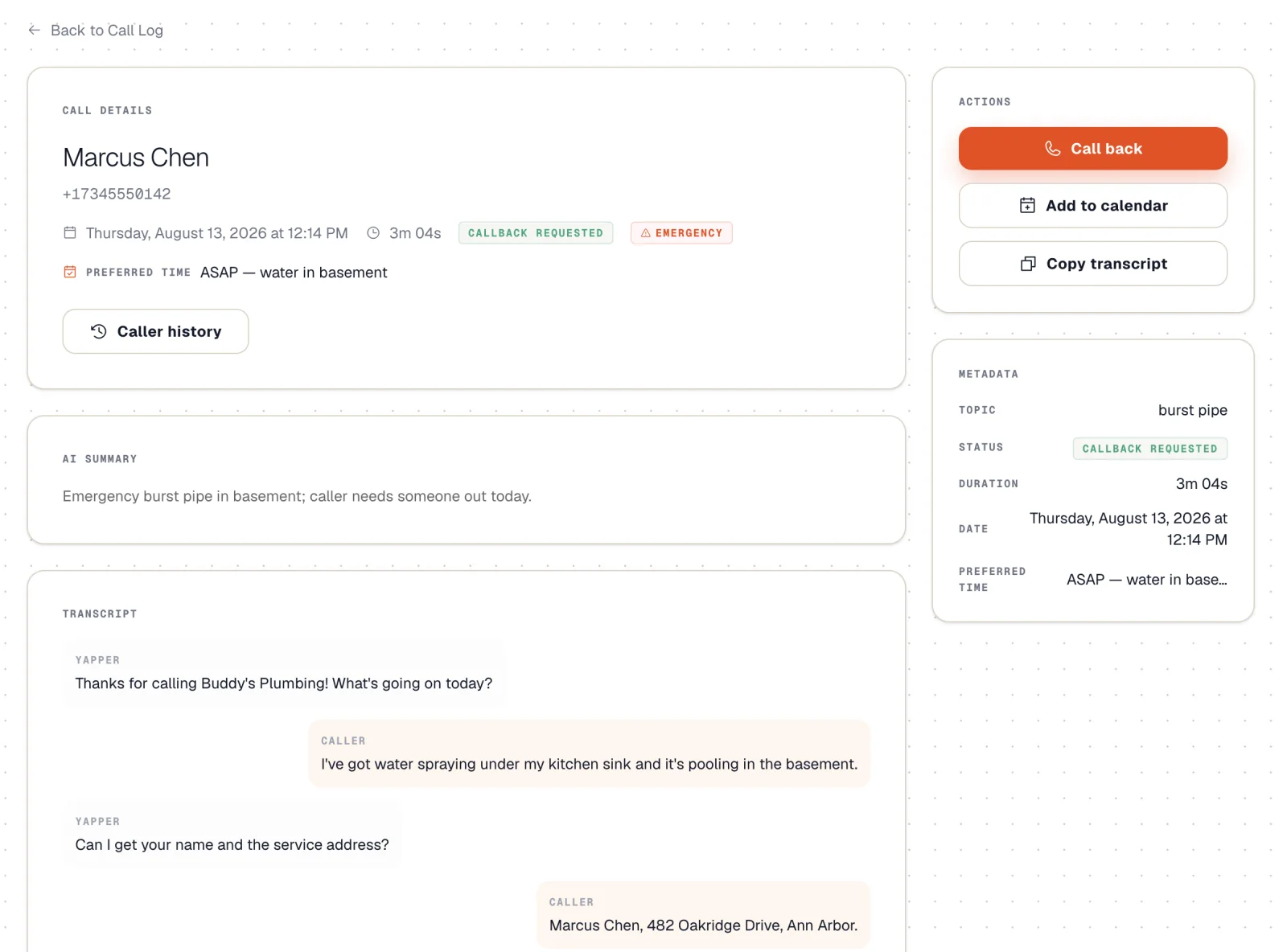
The follow-up summary was the must-have feature. After the call, the owner receives the caller's name, the request, any urgency, a preferred response time, and a link to the full record. They can decide what to do without calling into voicemail or reading an entire transcript.
The dashboard keeps the longer record: summary, status, transcript, audio when available, notes, and prior calls. The text and email carry the immediate decision; the dashboard is there when the owner needs detail.
The workflow in the product
Hear it
A Yapper demo call for an electrical business. The voice agent handles the request, and the owner receives the result by text and email.
How it works
Review the business
Enter a website URL and check the details Claude finds, or add the information manually. Setup takes less than five minutes.
Let Yapper take the call
Retell AI handles the conversation, gathers the caller's information and reason, and can transfer a Pro customer's emergency calls.
Act on the summary
The owner gets the useful details by text or email, then can open the dashboard for the transcript, recording, notes, and call history.
How it's built
01
Business line
A customer calls the number assigned to the business.
02
Retell AI
The voice agent runs the conversation and returns the call data.
03
Next.js webhooks
API routes receive call events and trigger the product workflow.
04
Supabase
The call, summary, transcript, status, and account data are stored.
05
Twilio + Resend
The owner receives the post-call summary by SMS, email, or both.
06
Owner dashboard
The business can review calls, usage, callers, and follow-up work.
Stripe handles billing. Vercel hosts the Next.js app and scheduled jobs. During onboarding, Claude extracts a first draft of the business profile for the owner to approve.
Key decisions
Use predictable pricing
I reviewed competitor pricing pages and saw low starting fees paired with per-call or usage charges. Yapper uses flat plans with included minutes so a small business can predict the bill: $199 for 200 minutes or $349 for 500 minutes. Annual billing saves two months.
Automate onboarding, then require review
A new customer enters a business URL and Claude extracts the name, services, hours, and other useful details. Yapper presents that work as an editable draft. The owner remains responsible for checking it, and businesses without a website can enter everything manually.
Keep scheduling off by default
Collecting the caller's information and sending a useful summary is low risk. Booking against incomplete availability can create conflicts and hurt the owner's relationship with the customer, so calendar scheduling is optional and limited to Pro.
Defer CRM connections and extra minutes
I did not know whether early customers needed CRM integrations, so I left them out. The same applies to minute add-ons. The dashboard and notifications show usage, and calls stop at the plan limit. I planned to ask early customers directly before building an overage product or choosing its price.
Test the conversation, not only the code
I called my own Yapper number about 50 times and tried unusual situations. Retell was generally accurate, but the first voice sounded robotic and more suited to a retail support line. I changed it to one that fit a trades business better.
Protect deliverability over perfect attribution
A Chrome extension showed email opens and link clicks, but testing indicated that it hurt Google deliverability. I removed it. That reduced visibility into engagement, but more of the outreach had a chance to reach the inbox.
After launch
The original seven-day trial required a credit card. When signups did not become trials, I reviewed every point where a customer might hesitate. Requiring a card can create fear of an immediate charge or a difficult cancellation, so I removed it. Billing is now added only if the customer decides to continue. I do not have enough trial volume to say whether the change improves conversion.
I tested cold email, follow-ups, and QR-code postcards. Origami ranked more than 1,000 leads by criteria such as business size, location, and review data, and the highest-scored prospects received the postcards. People created accounts, but no one began a trial.
That result made me question the channel as much as the product. Tradespeople are usually working rather than watching an inbox. I did not move to cold SMS because of consent and compliance risk, and I hesitated to cold call people whose phones are also their customer lines. Yapper remains live while I put my limited build time into other products and reassess the next validation test.
What went wrong
Twilio approval delayed the launch by almost two months. SMS was part of the core value, so I could not run a real launch without it. The site and product were ready while I waited, but the vendor dependency stopped the full workflow.
I also validated the category more than my offer. Larger companies already sell AI receptionist products, which proves that businesses buy the category. It did not prove that a small operator would buy my version, at my price, from me. If I started again, I would get four or five prospective owners to commit to paying and use their common requirements to define the first release.
The current default greeting does not proactively disclose that the caller is speaking with AI or that a call may be recorded and transcribed. Owners can edit the greeting, and the agent identifies itself as virtual if asked, but the safer product decision is to include disclosure and consent in the default flow while preserving owner controls. Durable consent records for caller texts also remain unfinished.
Results
- 1,000+ leads
- ranked and tested through cold email, follow-ups, and postcards during the initial distribution push.
- No trials
- after the first outreach test. Accounts were created. Nobody started a trial or paid.
- About 50 calls
- made to my own Yapper number to test the agent, edge cases, and voice fit.
- Under 5 minutes
- for website-assisted setup when the extracted business information is accurate.
- 2-month delay
- waiting for Twilio approval before the required SMS workflow could launch.
With more resources
The next serious test would be one focused month of daily, channel-specific marketing built around direct conversations with business owners. Three or four customers who stay beyond the first month would be enough evidence to continue investing. Zero customers after that test would be a reason to stop or rethink the offer.
Before that test, I would make disclosure and consent part of the default greeting, add durable consent records for caller texts, and keep the settings editable for businesses with different needs. I would still wait for customer evidence before adding CRM integrations, overage pricing, or a broader feature set.
Get it
Yapper has a seven-day free trial with no credit card required. Add billing only if you decide to continue.