- Role
- Solo builder
- Scope
- Reading experience, curation rules, daily publishing, and copyright boundaries
- Stack
- HTML, CSS, JavaScript modules, GitHub Actions, Vercel
- Outcome
- Live, and publishing a new edition every day
The problem
Most of what I read at night is a feed. It never ends, and very little of it is still worth reading a year later.
I wanted the opposite: a short, finished stack. Something current, something old, and a clear point where you are done for the night.
About
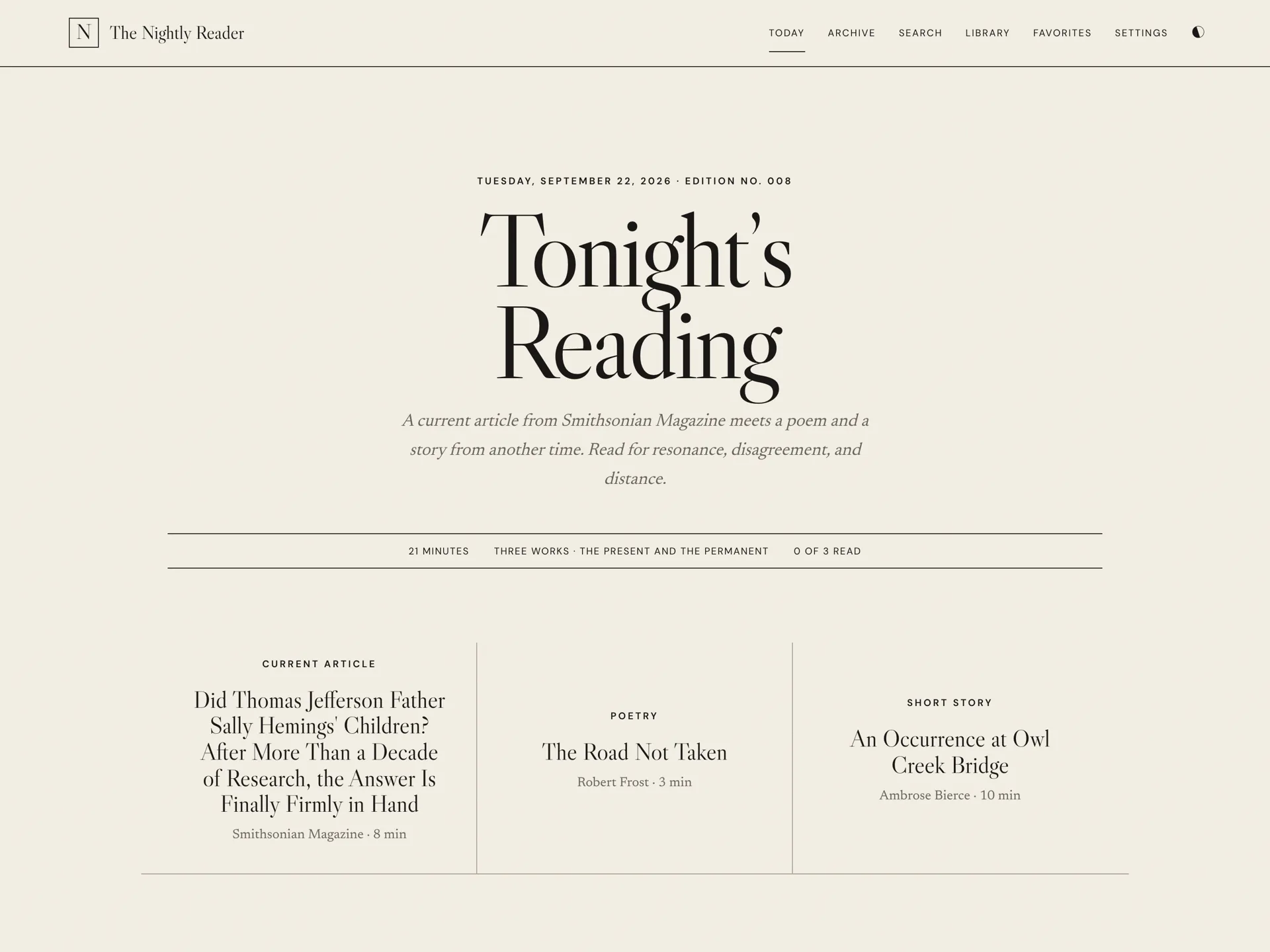
The Nightly Reader is a website that looks and reads like an evening paper. Each edition has three pieces. One current article from a publisher like Smithsonian or Aeon. One poem. One classic short story or essay, which switches each night.
The old works are in the public domain, so the full text is on the page. The current articles are not, so you get a short summary and a link to read the rest where it was published.
I built it in one night, in September 2026. By the next afternoon it was choosing and publishing its own editions.
The core idea
An edition that ends
The front page tells you the whole night up front: three works, about twenty minutes, and how many you have read. There is no infinite scroll and no “more like this.”
Each piece gets a real reading page: big type, a short note on why it was picked, and a place for a private reflection when you finish. Mark it read and it moves to your library.
How it works
Pick tonight's article
Every evening a scheduled job reads four publisher feeds and picks a recent article that has not run before.
Pair it with something old
It adds a poem and a classic story or essay, and avoids repeating recent authors and sources.
Check, then publish
Tests and a build run first. If anything fails, nothing ships and last night's edition stays up.
How it's built
01
Static site
Plain HTML, CSS, and JavaScript. No framework and no server. It loads fast and costs almost nothing to host.
02
Daily job
GitHub Actions runs once a day, writes the new edition, commits it, and deploys it to Vercel.
03
Four feeds
Smithsonian Magazine, Aeon, The Conversation, and The Public Domain Review. At least two must respond.
04
Full texts
Public-domain works are bundled or loaded from Wikisource, so you read them on the page.
05
Your data stays put
Progress, favorites, and notes live in your browser. Notes export to CSV or a backup file.
06
Guardrails
Ten checks cover sources, rights, unique works, variety, and running the same day twice.
Running the job twice on the same day does not make a second edition. It sees today already exists and stops.
Key decisions
Link to modern writing instead of copying it
Current articles belong to the people who wrote and paid for them. The Reader shows the publisher's own summary and sends you there for the full piece. Only public-domain work is shown in full.
No accounts
Notes about what you read are personal. They stay in your browser, and I cannot see them. You can export them any time.
Keep the last good edition if something breaks
A feed goes down, a test fails, a deploy gets rejected. In every case the site keeps showing last night's edition instead of a broken page.
Build it static first
The data is shaped so it could move to a real database later. For one reader a night, files and a daily job were enough.
What's built
- One night
- from an empty folder to a live site. Daily publishing was running by the next afternoon.
- Every day
- a new edition picked, checked, and published by a scheduled job, with no one pressing a button.
- Three works a night
- a current article, a poem, and a classic story or essay. About twenty minutes of reading.
- Archive, search, library
- plus favorites, private notes with CSV export, reading progress, and dark mode.
Inside an edition
With more resources
Accounts and a real database, so your library follows you between devices. Then search that understands what a piece is about, not just the words in its title.